The Walk · 3 of 14
PARALLEL TERRITORIES
How did different traditions divide inner life?
Chinese, Indian Buddhist, and Arabic partitions. Not translations of one English word.
Classical Chinese · Warring States
心
xin
Not the Chinese word for consciousness.
Indian Buddhist philosophy
- चित्तcittathe mental stream as lived
- मनस्manasthe thinking faculty
- विज्ञानvijñānadiscernment, momentary awareness
Not one Buddhist theory of mind.
Arabic philosophy · early eleventh century
نفس
nafs
Not Descartes' mind.
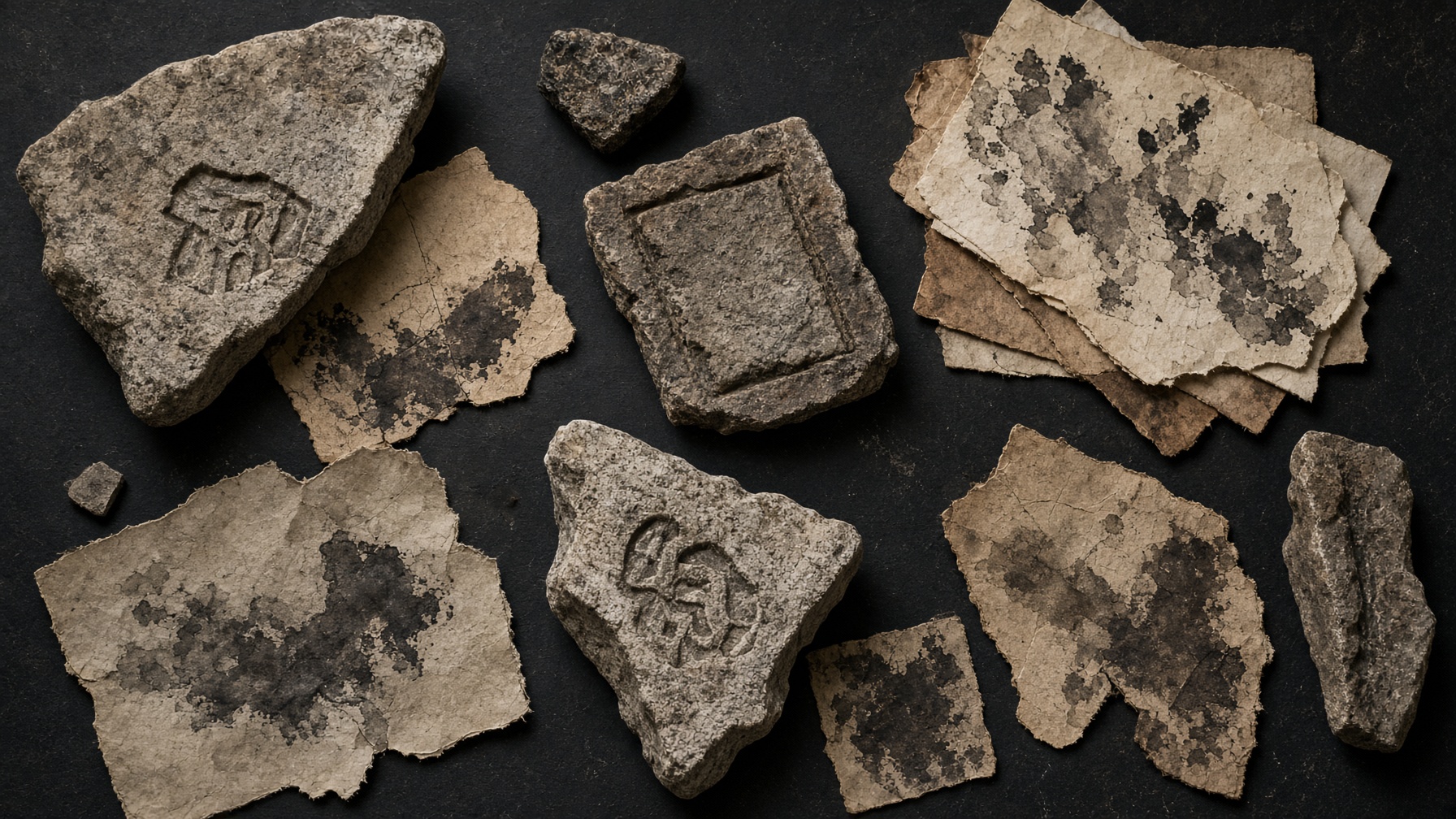
Fragments arranged as an atlas. These words live in different traditions. They are not interchangeable.
Hear
There is no Chinese word for consciousness waiting to be found, no Buddhist word, no Islamic word, that you can print as matching cards. That would be a false globe.
Different traditions carved the territory differently. In Warring States China, xin, the heart-mind, thinks, knows, desires, feels, and cultivates.
Heart and mind were not two words waiting to be married. Mengzi, Zhuangzi, and Xunzi, philosophers of that world, already disagree about what it is.
In Indian Buddhist philosophy, citta, manas, and vijñāna name different cuts of the mental.
From the early canons in India, then across Asia, schools disagree about whether awareness implies a self, whether it is momentary, whether it is reflexive.
In Arabic philosophy, in the early eleventh century, Avicenna, writing in Persia, uses nafs for a soul with faculties, including a self-awareness he can argue for even when the body is imagined away.
These are parallel territories. Visit them.
Leave them unannexed.
Documented
Xin is not consciousness
In Warring States China, roughly the fifth to third centuries before the common era, xin names a heart-mind that thinks, knows, desires, feels, and is cultivated. Same word.
Three worlds, in time. Mengzi taught that xin already has moral sprouts.
Zhuangzi asked whether a trained xin might also become a cage. Xunzi said human nature is not already good, so xin must be worked.
Scholarship translates xin as heart-mind because the term integrates cognition, affect, intention, and ethical work. Its importance for this project is the different partition, not a missing English word.
Documented
Buddhist disagreement
Citta, manas, and vijñāna cut the mental differently.
From the early canons in India, then across Asia, Buddhist philosophers disagree about whether awareness implies a self, whether it is momentary, and whether it knows itself.
Some deny a permanent self while still analyzing awareness in fine grain.
Reflexive awareness is affirmed in some later Yogācāra epistemologies, a school that takes mind as the primary field of analysis, and rejected in some Madhyamaka ones, which refuse to treat mind as a last substance.
These are not three translations of one English word, and not one Buddhist theory of mind.
Documented
Nafs
In the early eleventh century, Avicenna, Ibn Sina, writing in Persia in Arabic, describes nafs as a soul that organizes a living body, with internal senses and intellect.
It can, in a thought experiment, be known as existing without those senses. That is a different architecture of inner life, not a missing English word.
The next room is the experiment.
Sources
Stanford Encyclopedia of Philosophy. “Mind (Heart-Mind) in Chinese Philosophy.” Stanford Encyclopedia of Philosophy. consulted 2026.
Xin is not the ancient Chinese word for consciousness. It partitions thinking, affect, desire, and ethical cultivation together.
Stanford Encyclopedia of Philosophy. “Mind in Indian Buddhist Philosophy.” Stanford Encyclopedia of Philosophy. consulted 2026.
Citta, manas, and vijñāna are not one concept. Traditions disagree about self, momentariness, and reflexive awareness.
Stanford Encyclopedia of Philosophy. “Ibn Sina [Avicenna] / Arabic and Islamic Psychology.” Stanford Encyclopedia of Philosophy. consulted 2026.
Flying man in its own philosophical context. Caution against proto-Cartesian readings.