The Walk · 4 of 14
IF NOTHING OF THE BODY
If you could feel nothing of your body, would you still know that you exist?
Avicenna, early eleventh century. A thought experiment in the psychology of The Cure.
Hear
Imagine this. You are created all at once, fully formed.
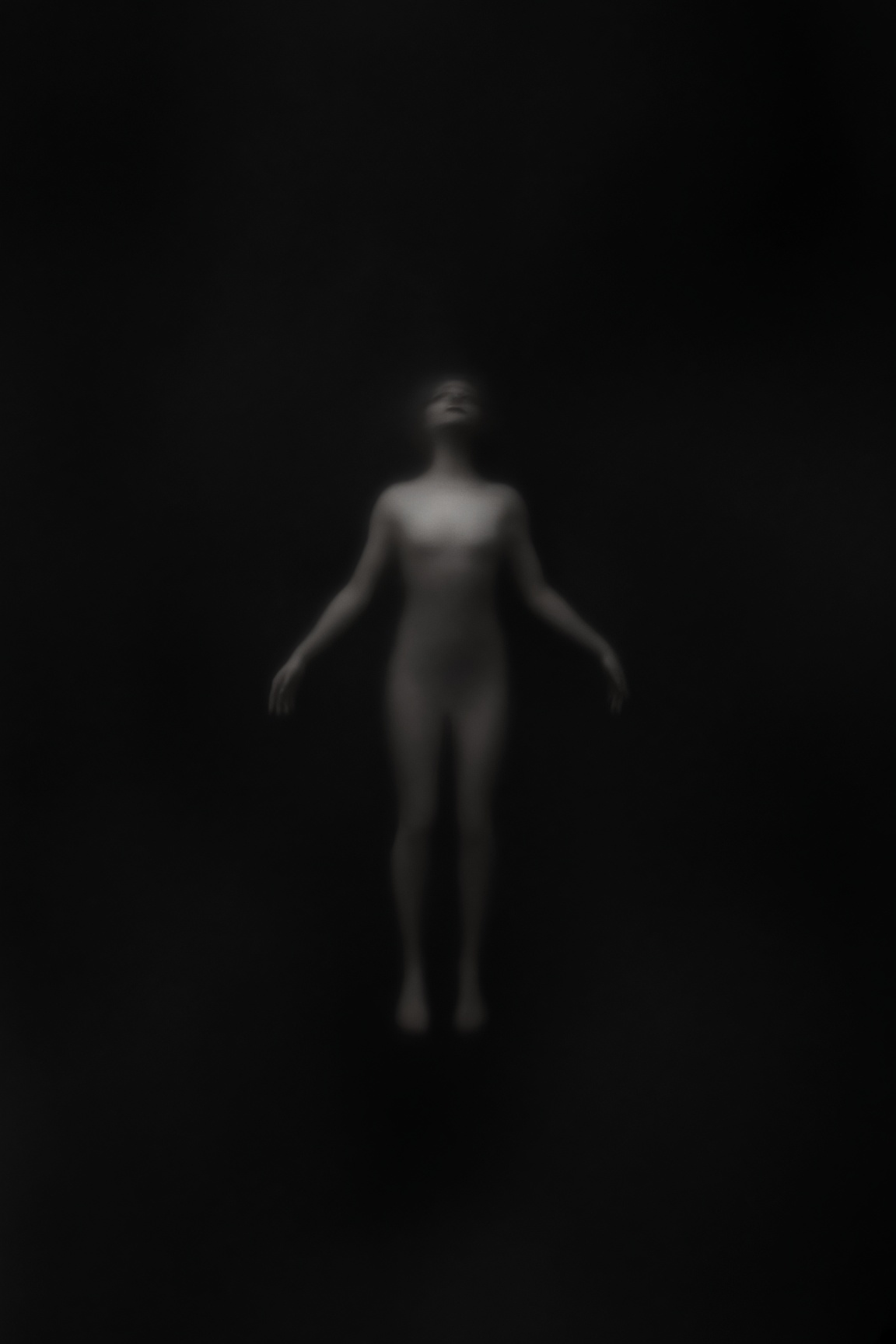
You are suspended. Your limbs do not touch.
You see nothing, hear nothing, feel no body. No floor.
No horizon. Would you still affirm that you exist?
Avicenna, Ibn Sina, writing in the Kitāb al-Nafs, the Book of the Soul, in the early eleventh century, says that you would. You would be certain of your self, without being certain of a body.
Therefore the self you affirm is not the body. This is not René Descartes, the French philosopher and mathematician who, in the 1640s, asked what he could still be sure of if the body and the senses were a trick.
Later readers hear him in this scene. The resemblance is real enough to explain the temptation.
Avicenna is six centuries earlier, working inside an account of nafs, a soul with a natural inclination for a body, faculties of sense and imagination, and an intellect in a Neoplatonic cosmos: a universe imagined as a cascade from a first source, through intellect and soul, into the material world.
The experiment is about the soul's self-subsistence and self-awareness. Let his problem remain his problem.
Then notice how often the question returns: can the mind know itself when the sensed world goes quiet?
Primary text
The suspended person
In the psychological part of The Cure, Avicenna's large philosophical work, he asks the reader to imagine a person created at a stroke, in mid-air or void, with no sensory input and no contact between the limbs.
That person, he argues, would still affirm their own existence. The existence affirmed is the existence of the soul, not of a body the person has no reason to posit.
Scholarly interpretation
Not proto-Cartesian
Later Latin readers, and much later historians, have heard René Descartes in this scene: a mind certain of itself while the body is in doubt. Descartes, 1596 to 1650, wrote the Meditations in the Dutch Republic.
The resemblance is real enough to explain the temptation. The contexts are not the same.
Avicenna's soul is emanated, given from a higher source, embodied by inclination, and equipped with internal senses.
The flying man is a thought experiment inside that system, not the founding of the modern claim that mind and body are two kinds of thing.
Limit
Knowing that I am is not knowing the world
The flying person knows that they are when there is nothing left to sense. That is not how Avicenna thinks we know a wolf, a triangle, or a meaning the eyes cannot see.
External senses take form. Estimation, wahm, grasps danger, usefulness, what is to-be-fled.
Intellect receives universals, in a contested partnership of abstraction and the Agent Intellect. Those are other machines in the same soul.
This room keeps the alert: self-awareness under subtraction. It does not teach his whole theory of knowledge.
Open question
Self without a sensed world
Can awareness of oneself survive the subtraction of the body, of floor, of horizon? Avicenna subtracts sensation.
He does not ask what a world must know how to do. A self without a sensed world is not yet a world.
That question lives in What Makes a World. Recurrence here is not a hidden doctrine, and not a descent from Eridu.
The question returns. Can the mind know itself?
Sources
Avicenna (Ibn Sīnā). Kitāb al-Shifāʾ, Kitāb al-Nafs. c. 1020s.
The flying or suspended person thought experiment. Argues that the soul can affirm its own existence without affirming a body.
Embedded in Avicenna's account of nafs, not a Cartesian proof.
Stanford Encyclopedia of Philosophy. “Ibn Sina [Avicenna] / Arabic and Islamic Psychology.” Stanford Encyclopedia of Philosophy. consulted 2026.
Flying man in its own philosophical context. Caution against proto-Cartesian readings.