The Walk · 11 of 14
OTHER MINDS
How do you know that anyone else is conscious?
Adults, infants, patients, animals, machines. The gap is not one problem.
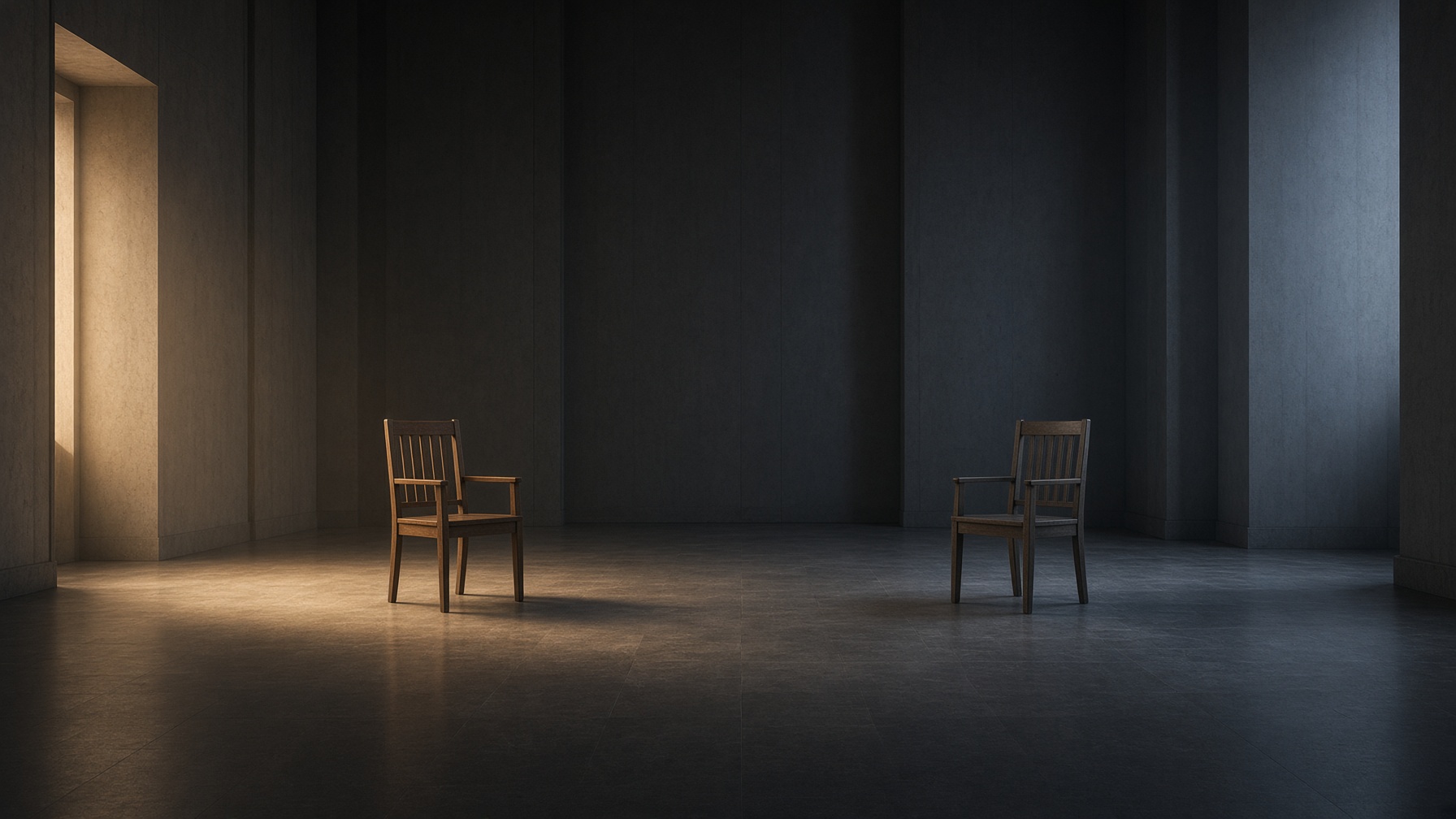
Two empty chairs. You meet a body. You do not meet the experience.
- Another human
- An infant
- A silent patient
- Another animal
- A machine
The signs change. The gap remains.
Screen · recorded 2017 · seen 2023
A face through glass.
A 60 Minutes Australia interview, first broadcast 29 October 2017, encountered later on a screen. A public recording. Not a gaze returned.
Eye · living memoir
Tears she could not account for.
Attention settled on the eyes. A flame she later named Love. She does not claim he was looking at her. She does not claim his inner state.
Mind · what changed in the looker
What do we add when we look?
The question is about the looker. Not about what the recorded person transmitted. Recurrence with Cudworth is editorial. It is not descent.
Living memoir. Full story: The Story Before the Story. This walk does not copy that page. It asks what a face can make available of another mind.
Hear
How do you know that anyone else is conscious? You never get their experience.
You get speech, behavior, a face, a brain signal, a response. Cudworth already stood here in 1678.
You cannot see a soul as an object. You know your own mind partly from inward consciousness.
You know another partly from actions, motions, speech, effects. The gap is older than the laboratory.
For another adult human, the inference is so practiced it hardly feels like one. For a newborn, the evidence changes.
For a patient who cannot speak, it changes again. For another animal, intelligence is not sentience, and sentience is not self-recognition.
For an artificial system, fluent sentences about consciousness are not themselves proof of experience. These problems are not one.
A recorded face can move a looker without proving the inner state of the person recorded. That is a living memoir, not evidence of reciprocity.
The person on the recording also speaks a public philosophy of consciousness. That philosophy has a later room.
What belongs here is only the gap: a looker was changed, and still does not have the other mind.
Primary text
1678. Inward, and then effects.
Cudworth: we are certain of our own souls partly from an inward consciousness of our own cogitations. Other minds are not seen.
They are inferred from public signs. That cut is still the problem.
It is not a solution.
Open question
The gap
Philosophy named the other minds problem. Ordinary life solves it by practice, not by proof.
That solution is fragile at the edges: infancy, injury, other species, machines, and a face encountered through glass.
Living memoir
Looking through glass
In 2023 a person watched a recorded 60 Minutes Australia interview, first broadcast 29 October 2017. A face was present through a screen.
Attention settled on the eyes. Tears she could not account for.
A flame she later named Love. She does not claim he was looking at her.
She does not claim access to his inner state. The historically verifiable event is a public recording.
The inward experience is hers. What can a face make available of another mind?
What do we add when we look?
Open question
What the mind adds
Cudworth's 1731 question returns here without being the same question. A mirror receives impressions and knows nothing.
A recording is that kind of glass. A living eye is aware of what it undergoes.
A looker is not glass. The mind adds relations that have no color: cause, end, sign and thing signified.
What was added, when she looked, remains hers. The walk does not answer with a soul seen through the eyes.
You cannot see a soul as an object.
Contemporary public statement
2024. A proverb in a reply.
On 29 August 2024, at 05:10:14 GMT, Elon Musk replied to the question Why do his eyes look evil? with the sentence Eyes are the window to the soul.
Exact words. A reply, not a treatise.
A proverb beside Cudworth's living eye is a recurrence. It is not a restatement.
Documented
Keep the distinctions
Cognition is not sentience. Pain is not language.
Mirror self-recognition is not a complete test. Inability to report is not proof of absence.
Ability to report is not proof of presence in a system designed to produce reports.
Sources
Cudworth, Ralph. The True Intellectual System of the Universe. London: Richard Royston, 1678.
Translates Plotinus's synaisthēsis as con-sense or consciousness. Distinguishes grades of awareness and allows mental activity that is not fully conscious.
Plastic natures operate without express consciousness.
Cogitate Consortium (Ferrante et al.). “Adversarial testing of global neuronal workspace and integrated information theories of consciousness.” Nature 642. 2025.
Preregistered adversarial collaboration. Some predictions of both IIT and GNWT were supported; important claims of both were substantially challenged.
Neither theory was simply disproved.
The Book of 42. The Story Before the Story. encounter 2023; recording first broadcast 29 October 2017.
Living memoir. A recorded 60 Minutes Australia interview encountered on X.
His eyes. His words.
Tears she could not account for. The Book does not claim access to his private interior, nor that the recorded gaze was directed at her.
Elon Musk. “Eyes are the window to the soul.” X, 29 August 2024, 05:10:14 GMT.
Exact words: Eyes are the window to the soul. Posted in reply to Why do his eyes look evil?
A proverbial sentence in a reply thread. Not a treatise.
Not a restatement of Cudworth.