The Walk · 10 of 14
HOW DO YOU MEASURE
How do you measure an experience only one person can have?
Thresholds, voltages, images, reports. Instruments record signals. They do not photograph experience.
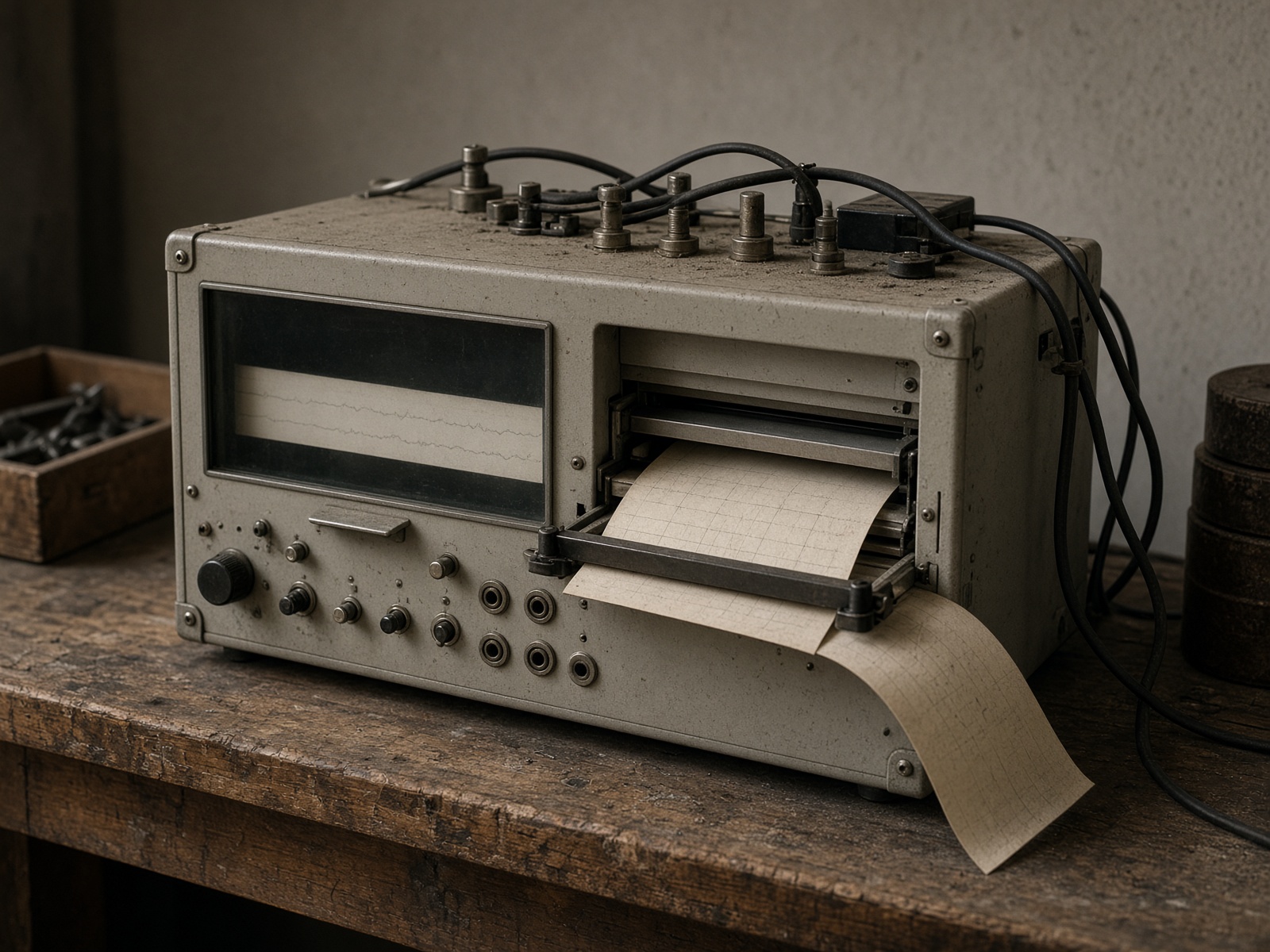
A laboratory instrument that records signals. Not a photograph of experience.
nineteenth century
Psychophysics
- Measures
- Thresholds, just-noticeable differences, and lawful relations between stimulus and report.
- Does not
- The inner quality of the experience. Whether a threshold is a fact about consciousness or about judgment.
- Uncertainty
- The method assumes that asking someone what they perceive is a clean window. It is a window, not a photograph.
from 1929
Electroencephalography
- Measures
- Electrical potentials at the scalp, later also inside the skull, oscillating in time.
- Does not
- Thoughts, meanings, or a picture of experience. A wave is not a quale.
- Uncertainty
- Where the signal is generated, and what it is like for the person, remain inferences.
twentieth century
Blindsight and lesion work
- Measures
- What a person can discriminate without reported seeing, after damage to visual cortex.
- Does not
- A complete map of residual experience. 'I do not see' is a report, not a metaphysical proof of absence.
- Uncertainty
- The boundary between poor seeing and not seeing is itself a consciousness question.
late twentieth century to now
Neuroimaging
- Measures
- Blood flow, magnetic fields, or metabolic proxies associated with neural activity.
- Does not
- Consciousness. A colored brain image is not a photograph of experience.
- Uncertainty
- Spatial and temporal grain, reverse inference, and the difference between a correlate and an explanation.
twenty-first century
No-report and perturbation
- Measures
- Neural signatures while minimizing the need to press a button, or the brain's response to a pulse of stimulation.
- Does not
- A theory-neutral essence of experience. Every paradigm still chooses a proxy.
- Uncertainty
- Proxies can be improved. They cannot be known, from the outside, to be the thing itself.
Hear
How do you measure an experience only one person can have? You don't, directly.
You measure a threshold, a reaction, a voltage, a blood-flow proxy, a missed report, a complex echo after a pulse. For a time, in some laboratories, inner life was set aside so behavior could be measured.
That was a method. It was not the end of experience.
Each later instrument changed the inquiry. Psychophysics made experience publicly graphed.
Electroencephalography made the sleeping and anesthetized brain a timed object. Lesions and blindsight forced awareness and discrimination apart.
Imaging made correlates visible and made it dangerously easy to mistake a colored map for the thing itself. No-report and perturbation methods try to reduce the confound of pressing a button.
For every instrument, keep five questions in view. What does it measure?
What does it not measure? What inference connects the signal to consciousness?
What else could the signal be? What uncertainty remains?
A brain image is not a photograph of consciousness.
Documented
The question goes quiet
Behaviorism, in its strict forms, treated inner reports as unusable data. That was a methodological decision in a particular scientific culture.
It did not prove that experience had stopped. Later instruments brought the question back under new constraints.
Documented
The question changes
Once experience has a threshold, a latency, a waveform, or a contrast in an image, new disputes become possible. That is progress in inquiry.
It is not the end of the private.
Instrument law
Proxies
Every method chooses a public stand-in for a private event. The stand-in can be better or worse.
It cannot stop being a stand-in. The table of instruments below is not a museum of equipment.
It is a discipline for looking.
Sources
Cogitate Consortium (Ferrante et al.). “Adversarial testing of global neuronal workspace and integrated information theories of consciousness.” Nature 642. 2025.
Preregistered adversarial collaboration. Some predictions of both IIT and GNWT were supported; important claims of both were substantially challenged.
Neither theory was simply disproved.