The Walk · 7 of 14
THE PERSON
How do you know what is happening in your own mind?
Locke, 1632 to 1704. Title page dated 1690. Person chapter, 1694.
1690 · first edition
Consciousness · reflection · knowledge
How do you know what is happening in your own mind?
John Locke, 1632 to 1704. Physician, philosopher, political thinker. Restoration England, and years in the Dutch Republic. People around him already spoke of soul, conscience, and ideas.
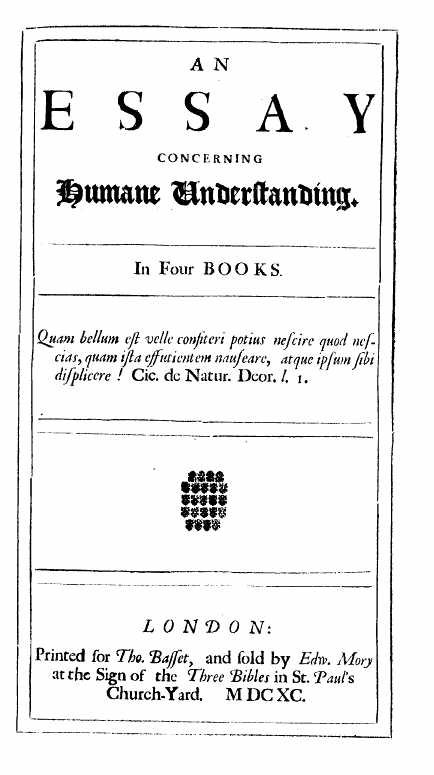
The title page is dated 1690. The book was circulating at the end of 1689. This room uses the title-page year as the public date.
Consciousness, here, is the perception of what passes in a man's own mind. It is not yet a theory of the person.
Source object. Public domain. London: printed by Elizabeth Holt for Thomas Basset, 1690. Scan via Wikimedia Commons. Not a modern reprint.
Then a chapter is added.
1694 · second edition
Book II · Chapter XXVII
Of Identity and Diversity
Typographic plate after the 1694 chapter heading. Not a photograph of the second-edition page. Added after encouragement from William Molyneux, Locke's correspondent in Dublin.
Person · identity · accountability
What makes you the same person?
A body changes. Memories change. Sleep interrupts awareness. Years pass. What does sameness mean?
A person, Locke writes, is a thinking intelligent being that can consider itself as itself in different times and places, which it does by consciousness. Person is a forensic term. It belongs to law, happiness, misery, reward, and punishment.
This is not the slogan that memory makes you the same person.
Body?
Soul?
Memory?
Consciousness?
Hear
Remember yourself years ago. A room.
A voice. A mistake you still know as yours.
What makes that you the same person as this you? Body?
Soul? Memory?
Consciousness? John Locke, 1632 to 1704, an English physician and philosopher, wrote the Essay Concerning Human Understanding in Restoration England and, for a time, in the Dutch Republic.
In 1690, in the first edition, he already treats consciousness as perception of what passes in one's own mind. In 1694, in the second edition, he adds Book Two, Chapter Twenty-Seven, “Of Identity and Diversity”.
That is where persons enter with full force. A person is a thinking intelligent being that can consider itself as itself in different times and places, which it does by consciousness.
Person, he says, is a forensic term. It belongs to intelligent agents capable of law, happiness, and misery.
It appropriates actions and their merit. If you are not conscious of an action as yours, in what sense should you be answerable for it?
This is not the slogan that memory makes you the same person. Consciousness, for Locke, is not simply recall.
Scholarship has spent a generation resisting that simplification.
The moment
How do you know what is happening in your own mind?
Thoughts arrive without being asked. Sleep cuts the scene.
A body changes while something still answers to you. John Locke was born in 1632 in Somerset.
He trained as a physician. He wrote in Restoration England and, for a time, in the Dutch Republic.
The people around him already had soul, conscience, and ideas. They did not yet have a working English word called consciousness in the way his Essay would use it.
Documented
1690. The first edition.
The title page of An Essay Concerning Humane Understanding is dated 1690. The book was already circulating at the end of 1689.
The walk uses the title-page year as the public date of the first edition, and records the 1689 circulation here rather than collapsing the two. The printed title uses Humane.
Later editions print Human.
Primary text
What passes in a man's own mind
In the first edition, consciousness is the perception of what passes in a man's own mind. It belongs with reflection, ideas, and knowledge.
It is not yet Book II, Chapter XXVII. The identity argument belongs to 1694.
Documented
1694. The person as a forensic term.
The second edition of 1694 adds “Of Identity and Diversity”. William Molyneux, Locke's correspondent in Dublin, encouraged the addition.
A person is a thinking intelligent being that can consider itself as itself in different times and places, which it does by consciousness. Person, Locke says, is a forensic term.
It belongs to intelligent agents capable of law, happiness, and misery. It appropriates actions and their merit.
If you are not conscious of an action as yours, in what sense should you be answerable for it?
Primary text
Man, soul, person
Locke pries the terms apart. The same man may not be the same person.
The same soul may not secure the same person.
Personal identity reaches as far as consciousness can be extended, including through memory, but the theory is an account of appropriation and accountability, not a storage test.
Scholarly interpretation
Not a memory criterion
Shelley Weinberg, a contemporary scholar of Locke, reads Lockean consciousness as a non-evaluative self-referential awareness internal to perception: awareness that points to itself without yet judging right or wrong.
Ruth Boeker stresses personhood as moral and forensic. Thomas Reid, an eighteenth-century Scottish philosopher, objected with a story of a brave officer.
The officer remembers being flogged as a boy. Later, as a general, he remembers taking a standard as the officer, but not the flogging.
If sameness were only a chain of memories, the general would be the boy. If consciousness of the flogging is required, he would not.
That treats consciousness as transitive memory. That is one of the simplifications this room is here to block.
Limit
What this story does not prove
It does not prove that consciousness is only memory. It does not prove that 1690 and 1694 are the same intervention.
It does not settle whether Locke's forensic person requires his theology. The question of answerability outlives that theology.
Open question
Answerability
If you are not conscious of an action as yours, in what sense should you be answerable for it? That is the 1694 return.
It is not the 1690 question. Both remain open.
Sources
Locke, John. An Essay Concerning Humane Understanding, first edition. 1st ed.. London: Thomas Basset, 1690.
Title page dated 1690. Circulating by late 1689.
Printed title uses Humane. Already contains Locke's account of consciousness as perception of what passes in one's own mind.
Does not yet contain Book II, Chapter XXVII.
Locke, John. An Essay Concerning Humane Understanding, second edition. 2nd ed.. London: Awnsham and John Churchill, 1694.
Adds the major treatment of persons and personal identity after encouragement from William Molyneux. Person is a forensic term.
Identity of the person is tied to consciousness, not simply to body or soul. This chapter is 1694, not 1690.
Stanford Encyclopedia of Philosophy. “Locke on Personal Identity.” Stanford Encyclopedia of Philosophy. consulted 2026.
Dates the identity chapter to the 1694 second edition. Distinguishes consciousness from a simple memory theory.
Weinberg, Shelley. Consciousness in Locke. Oxford: Oxford University Press, 2016.
Consciousness in Locke as non-evaluative self-referential awareness internal to perception, not identical with memory or reflection.
Boeker, Ruth. Locke on Persons and Personal Identity. Oxford: Oxford University Press, 2021.
Personhood, moral accountability, and why Locke's theory is not a simple memory criterion.